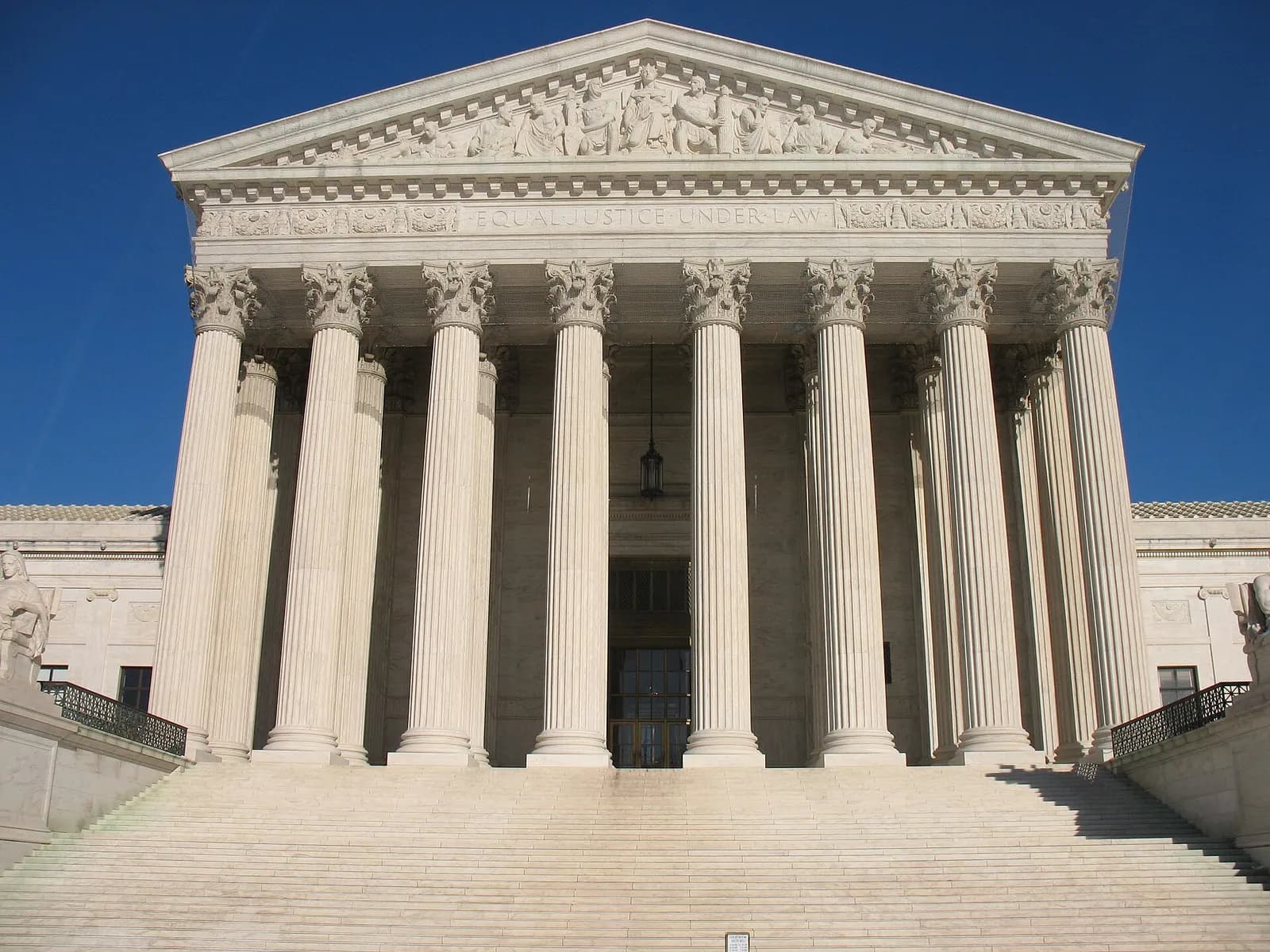
Reestablishing Separation of Powers
If any branch encroaches on the domain of another, the balance that keeps our nation free is at risk. Nationwide injunctions and the Impoundment Control Act show how far the lines have blurred.
The Overview
The facts, straight
Written February 2025. Not previously published.
Editor's note: Since this was written, the Supreme Court limited universal injunctions in Trump v. CASA (June 27, 2025) and overruled Humphrey's Executor in Trump v. Slaughter (June 29, 2026). The argument below is as written in February 2025.
Since the founding of our nation, legal scholars and government officials have debated where the boundaries of the separation of powers lie. Our Constitution sets out three branches of government, all of them, on paper, equally powerful. The debate stretches back to Marbury v. Madison, where the Court had the good judgment to recognize that its power was limited when it came to areas of authority the Constitution assigns to another branch. Judicial restraint and the political question doctrine have often been cited as reasons for courts to stay out of matters where their authority is not absolutely clear cut.
If any branch encroaches on the domain of another, the careful balance of powers that keeps our nation free is at risk. Each branch has a duty to restrain its own activities. The judicial branch has clearly lost sight of that restraint, and the other branches must reinforce the boundaries to avoid a slippery slope toward judicial authoritarianism.
Nationwide Injunctions
Our system of checks and balances necessarily gives each branch some authority to hold the others accountable to the Constitution, the law and the people. In recent years, federal district judges have issued a rash of broad nationwide injunctions that go far beyond the geographic and constitutional limits on their authority. Who is to challenge these power grabs?
In recent decades, when a judge has ordered the Executive Branch to do or not do something, even something squarely within the Executive's authority under Article II, the Executive has usually relented to avoid a so-called "constitutional crisis." The fact is that past Presidents ceded portions of the Executive Branch's authority by doing so, and it is time to revisit the separation of powers as the framers of our Constitution intended it.
If we intend to be governed by three separate branches of government, we must also reclaim the power improperly granted to so-called "independent agencies" under Humphrey's Executor v. United States.
Elections Should Have Consequences
One danger of an unchecked judiciary is the erosion of electoral consequences. If any of the hundreds of federal district judges can substitute their own view of how the Executive Branch should carry out its internal duties, we run the risk of excessive power concentrating in the Judicial Branch.
The Executive Branch's chain of command ultimately runs to the citizens who vote in presidential elections. Untether that connection and the President becomes a mere figurehead, and we are governed instead by officials the public cannot hold accountable at the ballot box.
When Courts Cross the Line
The judicial branch has encroached on legislative authority by inventing doctrines such as qualified immunity, which overrode the protections Congress wrote into 42 U.S.C. § 1983, along with other judge-made doctrines that limit the clear language of the legislative branch without any plain connection to a limiting principle in the Constitution.
The judicial branch has also routinely encroached on Executive Branch authority, most recently by micromanaging the operations of Executive Branch agencies. Any time a court micromanages without a clear constitutional mandate to do so, it undermines the public's faith in the judicial system. No official should be trusted with power if he is unwilling to recognize the limits on that power.
Congress Crosses the Line, Too
The Legislative Branch routinely encroaches on Executive Branch authority as well, by seeking to legislate fine details and micromanage how the Executive carries out the laws. One example is the Impoundment Control Act, which essentially says the President must spend money if Congress allocates it for a given cause. This is not constitutionally founded. Congress can opt to shut off funds if it dislikes how a President carries out the laws, but it cannot force a President to spend funds just because they are allocated.
The President has great discretion under Article II in how he carries out the laws, and it is a legitimate exercise of executive authority to refuse to spend funds when the President believes the nation would be better served by conserving them. This is particularly true in foreign relations and military operations, and any time such spending would increase our national debt and thus imperil our national security.
Adapted from Keith Gross's writing, originally written February 2025.
Sources & Citations
- Legal Information Institute, “Marbury v. Madison, 5 U.S. 137 (1803)”.
- Legal Information Institute, “Humphrey's Executor v. United States, 295 U.S. 602 (1935)”.
- Legal Information Institute, “U.S. Constitution, Article II”.
- Legal Information Institute, “42 U.S.C. § 1983, Civil action for deprivation of rights”.
- Legal Information Institute, “Impoundment Control Act, 2 U.S.C. ch. 17B (2 U.S.C. § 681 et seq.)”.
- Supreme Court of the United States, “Trump v. CASA, Inc., No. 24A884 (June 27, 2025)”.
- Supreme Court of the United States, “Trump v. Slaughter, No. 25-332 (June 29, 2026)”.
Positions above are attributed to the public statements and published reporting cited here. Quotations are taken from these sources; Radio Purple does not publish unattributed or invented quotes. See an error? Request a correction.