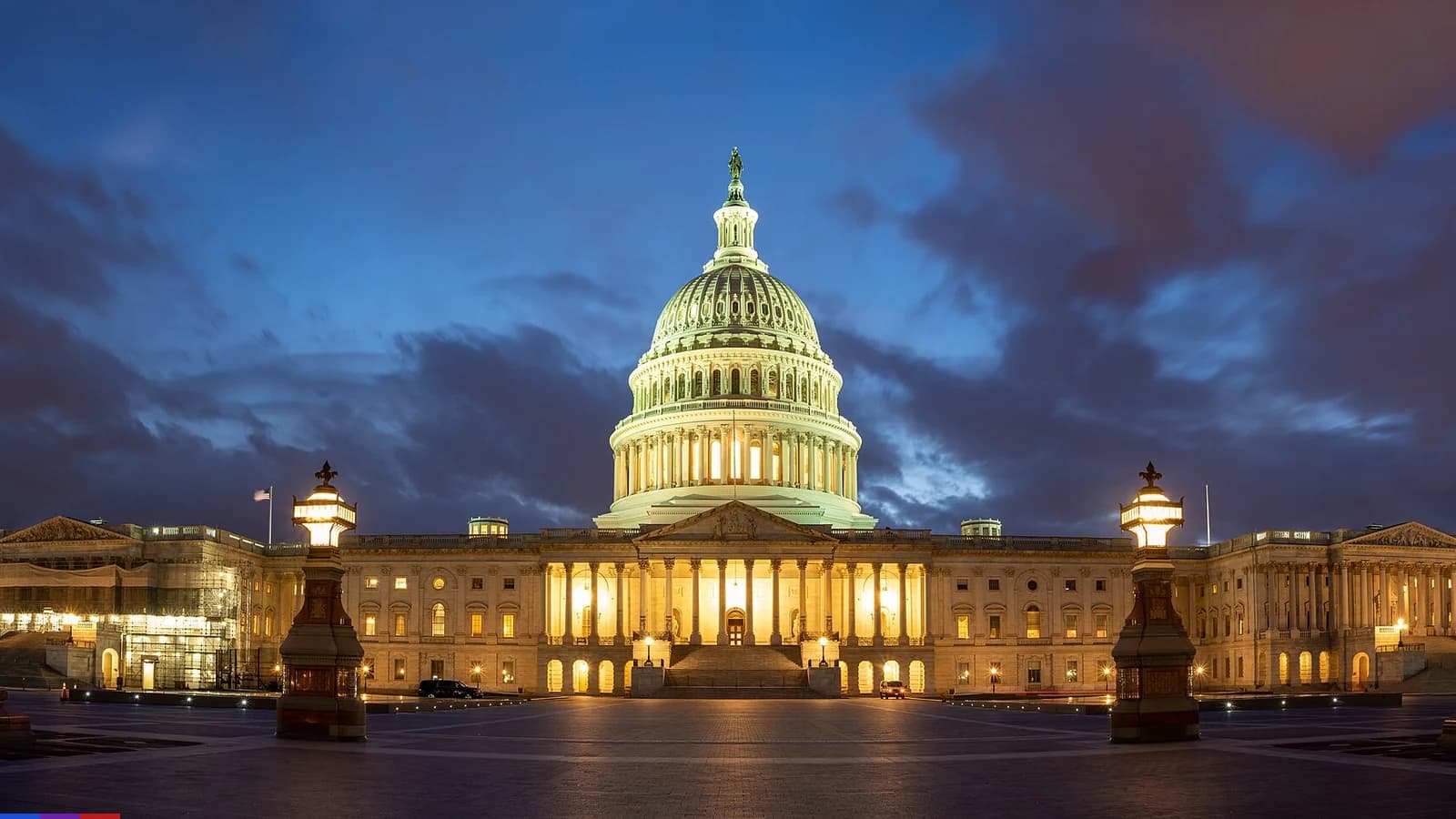
Democrats Win the House and Senate, AP Calls. What Divided Government Means for Trump's Final Two Years: Vetoes, Subpoenas, Nominees and a December Funding Deadline
The Associated Press called the Senate for Democrats late Tuesday and the House early Wednesday. Republicans keep their majorities through a lame-duck session with a Dec. 11 funding deadline, and the new Congress is sworn in Jan. 3. Here is what changes, what doesn't, the veto math, and what each side says comes next.
By Evelyn Shaw, Constitution Explained
Published · 8 min read
The Overview
The facts, straight
What's been called. Democrats will control both chambers of Congress for the last two years of President Trump's term. The Associated Press called the Senate for Democrats late Tuesday night and the House early Wednesday morning (AP via PBS; AP via PBS). NBC News and CBS News project the same result in both chambers. Many races are still being counted, so every number below is a projection or a count as of about 6 a.m. Eastern Wednesday.
The Senate. NBC News' count had Democrats at 54 seats and Republicans at 44, with Alaska and Mississippi not yet called (NBC News). NBC's 54 includes the independents who caucus with Democrats. Before the election, Republicans held 53 seats (CBS News). The AP reports Democrats flipped seven Republican-held seats:
- Iowa: Josh Turek defeated Rep. Ashley Hinson.
- Kansas: Adam Hamilton defeated Sen. Roger Marshall, becoming the state's first Democratic senator since 1932.
- Maine: Troy Jackson defeated Sen. Susan Collins.
- North Carolina: Roy Cooper won the open seat.
- Ohio: Sherrod Brown defeated Sen. Jon Husted in the special election.
- South Carolina: Annie Andrews defeated Darline Graham.
- Texas: James Talarico defeated Ken Paxton.
Democrats also held Georgia (Sen. Jon Ossoff), New Hampshire (Rep. Chris Pappas) and Michigan (Abdul El-Sayed), according to AP and CBS. In Alaska, Republican Sen. Dan Sullivan led Democrat Mary Peltola 48.5% to 47.7% with about 72% counted. Alaska ranks candidates, and its final tabulation comes later. The Justice Department has also sued over certification there. Mississippi was tied at 48.9% each with about 96% counted, per NBC.
The House. By about 6 a.m. Eastern, NBC had called 231 seats for Democrats and 144 for Republicans, with 60 still uncalled. Its Decision Desk estimates Democrats will finish with about 258 seats to 177 for Republicans, and says that number could move a few seats either way (NBC News). It takes 218 seats to hold a majority. According to the AP, Democrats passed 218 when Johnny Garcia won Texas' 35th District (Anadolu Agency, citing AP). Republicans went in holding 218 seats to Democrats' 214, CBS reported. For why the last races can take days, see our explainer on race calls.
What doesn't change yet. The current Congress, with Republican majorities in both chambers, comes back for a lame-duck session. Speaker Mike Johnson and Senate Majority Leader John Thune stay in charge until the new Congress is sworn in at noon on Jan. 3, 2027, the date the 20th Amendment sets (National Archives). The new House then elects its speaker. House Democratic Leader Hakeem Jeffries is "in line to make history as the nation's first Black speaker of the House," the AP reported. Senate Democrats haven't held leadership elections yet.
What divided government changes, starting in January:
- Oversight and subpoenas. House rules let committees issue subpoenas for testimony and documents (House Rule XI, cl. 2(m)). The majority chairs every committee, so Democrats will decide what gets investigated. According to the AP, party leaders "have signaled they'll use a foothold in Congress" to investigate top administration officials, naming Defense Secretary Pete Hegseth and Elon Musk as possible targets, and impeachment "is not off the table." The House can impeach by simple majority. Removing an official takes two-thirds of the Senate (Constitution, Art. I, Sec. 3).
- Confirmations. The Senate confirms Cabinet officers, federal judges, U.S. attorneys and other nominees (Senate.gov). Since rule changes in 2013 and 2017, a simple majority can end debate on any nomination, Supreme Court nominees included (CRS R43331; CRS R44819). That rule helped Republicans confirm nominees quickly. Now it helps the Democratic majority, which will run the Judiciary Committee and the floor schedule. CBS put it this way: "With the majority, Democrats can block the president's nominees and control what measures receive votes on the floor."
- The veto, and the override math. To override a veto, two-thirds of each chamber has to vote yes (Constitution, Art. I, Sec. 7; Senate.gov). With every member voting, that's 290 in the House and 67 in the Senate. On the projections above, Democrats would need about 32 House Republicans and, depending on how Alaska and Mississippi go, 11 to 13 Senate Republicans. The other side of that math: to sustain a veto, Trump needs only 146 House members or 34 senators, and Republicans are projected to hold more than that in each chamber. In practice, bills that become law will need the president's signature or a lot of Republican votes.
The deadlines both parties face. Government funding runs out Dec. 11, when the current continuing resolution expires. Congress has to pass full-year spending bills or another short-term extension, or agencies start to shut down (Holland & Knight; CSIS). The annual defense policy bill, the NDAA, hasn't passed yet either. The House passed its version 216-212 on July 22. In the Senate, a July 14 vote to take up its version fell short, 50-46, and the bill hasn't come back to the floor (CRS). Negotiators are working toward a compromise for the lame duck. CSIS counted 22 Senate and 20 House session days left in the year. Other items with year-end deadlines include highway programs, parts of the farm bill and several health programs, per Holland & Knight.
Both parties' leaders have spoken. Here's what each side says the result means.
What the Left Says
The progressive and Democratic case
Democrats call it a mandate on cost of living and accountability. Senate Democratic Leader Chuck Schumer called the results a "generational remake of the Senate map," the AP reported. Overnight he posted:
Post: Sen. Chuck Schumer (@chuckschumer) on X, Nov. 4, 2026.
The Senate Democrats' account was blunter: "Democrats focused on what Americans wanted, and with a Senate majority, we will deliver that—with or without Trump" (@SenateDems). At a news conference, Schumer said he'd heard Trump say he would work with a Democratic Congress, but that Democrats are "going to deliver for the people of America with or without the president," according to congressional reporter Burgess Everett, whose post Schumer shared with the comment above.
Jeffries said "the American people are crying out for transformational change," the AP reported. In a video posted overnight, he described the night in less partisan terms:
Post: Rep. Hakeem Jeffries (@hakeemjeffries) on X, Nov. 4, 2026. In the video he says, "This is not a partisan moment. This is a patriotic one."
House Democrats have already laid out what they'd do first. Their 100-day agenda centers on lowering the cost of living and aggressive oversight of the administration. Democrats point to the AP Voter Poll of the midterm electorate. About three-quarters of voters said the economy is "not so good" or "poor." Roughly half called government corruption and the cost of living "crucial" to their vote, and about 6 in 10 said Trump puts his own interests ahead of the country's (AP via PBS). In its own words, the AP called the result "a decisive rebuke of Republican governance in Washington."
Where Reality Likely Sits
Radio Purple's analysis
What both sides say about working together. Trump told The New York Times "we'll probably work something out" and said he looks forward to working with Democrats, the BBC reported. Thune wrote that he's "looking forward to the important work we have in front of us over the next few months." Schumer says Democrats will act "with or without the president." That leaves room for deals, especially on bills that have to pass. Funding the government past Dec. 11 and finishing the defense bill have to happen no matter who controls Congress. Through the lame duck, those votes happen under the current Republican majorities.
What the numbers settle:
- Control. The AP, NBC and CBS all have Democrats winning both chambers. That won't change as the remaining races finish counting. Only the size of the majorities is still open.
- Timing. Nothing changes hands until Jan. 3. Until then, Republicans run both chambers.
- Vetoes. On the projections, neither chamber has a veto-proof Democratic majority. Overriding Trump would take about 30 or more House Republicans and roughly a dozen Senate Republicans.
- Nominees and subpoenas. Starting in January, a Democratic Senate can confirm or block nominees by simple majority, and Democratic House chairs control committee subpoenas.
What they don't settle:
- The final seat counts. Alaska and Mississippi decide whether Democrats finish with 54, 55 or 56 Senate seats. In the House, 60 races were uncalled as of about 6 a.m. Eastern.
- What actually passes. Democrats can pass bills Trump opposes and send them to his desk. He has said he'll veto them, and Republicans have the votes to sustain those vetoes. How much becomes law depends on whether either side moves.
- How hard oversight goes. Investigations are almost certain. The AP says leaders haven't ruled out impeachment. We found no announced articles of impeachment as of early Wednesday.
For voters, the practical part: the government's funding deadline is Dec. 11, and the new Congress takes over Jan. 3. For how the races got here, see our pre-election look at what the polls said. For one nomination already waiting on the Senate, see The Bill for 2022 Comes Due.
What the Right Says
The conservative and Republican case
Republicans say the result follows midterm history, not a verdict on their record, and that the president's veto still sets the limits. Speaker Johnson told supporters on Tuesday night that keeping the House meant they "would have to defy more than a century of midterm history." "It's very, very difficult to overcome, and it looks like history will be kept," he said. "We double down... And come 2028, we will take back the House, and we will finish this job" (Washington Examiner).
Thune defended the majority's record. He cited preventing what he called "the largest tax hike in American history," border enforcement and the pace of Cabinet and judicial confirmations, and wrote that "Senate Republicans will not stand idly by as the far-left, socialist wing of the Democrat Party attempts to unwind everything we've done":
Post: Senate Majority Leader John Thune (@LeaderJohnThune) on X, Nov. 4, 2026.
President Trump said the losses weren't about him. "I wasn't on the Ballot and if I was, we would have won IN A LANDSLIDE!" he wrote on Truth Social, according to the AP. In interviews, he said Democrats "did a good job" and that he is "absolutely willing to accept" the results. He blamed some candidates and higher gas prices tied to the Iran war (BBC). He also posted a red cap printed with the word "VETO" and said he'd use that power:
Post: Rapid Response 47 (@RapidResponse47) on X, Nov. 4, 2026. Trump says Democrats will "send over things that are insane and I'll veto them," and then, "after a couple of months of vetoes," the two sides would "work together."
We found no public statement on the results from Vice President JD Vance as of early Wednesday.
Sources & Citations
- Associated Press (via PBS News), “Democrats take control of the Senate after winning key midterm races”, November 3, 2026.
- Associated Press (via PBS News), “Democrats win control of U.S. House, in major rebuke to Trump”, November 4, 2026.
- Associated Press, “Democrats win the US House and Senate as voters deliver a strong rebuke to Trump and Republicans”, November 4, 2026.
- Associated Press, “This time, determining which party will control Congress didn't take days”, November 3, 2026.
- Anadolu Agency, “Democrats projected to win control of US House in midterm elections”, November 4, 2026.
- NBC News, “U.S. Senate Election 2026 Live Results”, November 4, 2026.
- NBC News, “U.S. House Elections 2026 Live Results”, November 4, 2026.
- NBC News, “Democrats win control of the House and vow to keep Trump in check”, November 4, 2026.
- CBS News, “Democrats win majority in the Senate, flipping control of upper chamber”, November 3, 2026.
- CBS News, “2026 House election live results”, November 4, 2026.
- BBC News, “Trump takes aim at Republicans but says Democrats did a 'good job'”, November 4, 2026.
- Washington Examiner, “Mike Johnson says it 'looks like history will be kept' for Republicans losing House majority”, November 3, 2026.
- X (@chuckschumer), “Chuck Schumer post on X”, November 4, 2026.
- X (@hakeemjeffries), “Hakeem Jeffries post on X (video)”, November 4, 2026.
- X (@SenateDems), “Senate Democrats post on X”, November 4, 2026.
- X (@burgessev), “Burgess Everett post on X (Schumer news conference), quoted by Schumer”, November 4, 2026.
- X (@LeaderJohnThune), “John Thune post on X”, November 4, 2026.
- X (@RapidResponse47), “Rapid Response 47 post on X (President Trump on divided government and the veto)”, November 4, 2026.
- Holland & Knight, “Beyond the Midterms: Congress Faces Converging Year-End Deadlines”, October 1, 2026.
- Center for Strategic and International Studies, “FY 2027 Defense Funding: Potential Post-Midterm Outcomes”, January 1, 2026.
- Congressional Research Service, “FY2027 NDAA: Status of Legislative Activity (IN12704)”, January 1, 2026.
- National Archives, “The Constitution of the United States: A Transcription (Article I, Section 7)”, January 1, 1787.
- National Archives, “The Constitution: Amendments 11-27 (Twentieth Amendment)”, January 1, 1933.
- U.S. Senate, “Vetoes”, January 1, 2026.
- U.S. Senate, “Nominations”, January 1, 2026.
- Congressional Research Service, “Majority Cloture for Nominations: Implications and the 'Nuclear' Proceedings of November 21, 2013 (R43331)”, January 1, 2013.
- Congressional Research Service, “Senate Proceedings Establishing Majority Cloture for Supreme Court Nominations: In Brief (R44819)”, January 1, 2017.
- House Committee on Rules, “Rules of the House of Representatives (Rule XI, clause 2(m), subpoena power)”, January 1, 2025.
Positions above are attributed to the public statements and published reporting cited here. Quotations are taken from these sources; Radio Purple does not publish unattributed or invented quotes. See an error? Request a correction.