Supreme Court Leaves Maryland's 'Sensitive Places' Gun Limits in Place
The justices turned away a challenge to Maryland's bans on carrying guns in parks, on transit, in bars and elsewhere. Justice Clarence Thomas agreed with passing on this case but said the Court should take up a narrower one.
By Evelyn Shaw, Constitution Explained
Published · 4 min read
The Overview
The facts, straight
The Supreme Court on Monday declined to hear a challenge to Maryland's laws barring people from carrying guns in a long list of public places. The laws stay in effect.
The docket entry for Novotny v. Moore reads: "Petition DENIED. Statement of Justice Thomas respecting the denial of certiorari." The denial appears in Monday's order list. No justice noted a dissent. The Court had scheduled the petition for its private conferences several times since September before acting.
The denial leaves in place a January ruling by the U.S. Court of Appeals for the Fourth Circuit, Kipke v. Moore. That court upheld Maryland's bans on carrying guns in government buildings, on mass transit, on school grounds, within 1,000 feet of a public demonstration, in state parks and forests, in museums and healthcare facilities, at stadiums, racetracks, amusement parks and casinos, and in places that sell alcohol for on-site consumption. It also unanimously struck down one rule: a default ban on carrying guns on private property open to the public unless the owner allows it.
Many of these bans came from Maryland's Gun Safety Act of 2023. That law passed after the Supreme Court's 2022 Bruen decision, which held that the Second Amendment protects carrying a gun in public. The challengers are individual gun owners and four gun-rights groups: Maryland Shall Issue, the Second Amendment Foundation, the Firearms Policy Coalition and the Maryland State Rifle & Pistol Association.
Thomas's statement. Justice Clarence Thomas, who wrote Bruen, agreed the Court shouldn't take this case but signaled interest in a future one. "I am skeptical that each of these laws 'is consistent with this Nation's historical tradition of firearm regulation' in 'sensitive places,'" he wrote in his statement. "Still, I agree with the Court's decision not to grant certiorari. Because each Maryland statute implicates a distinct historical tradition of firearm regulation, the breadth of petitioners' challenge would complicate our review." He added: "In an appropriate and more narrowly focused case, however, we should consider the scope of States' authority to ban firearms in 'sensitive places.'"
Denying review doesn't mean the Court agreed with the lower court. Thomas wrote only for himself.
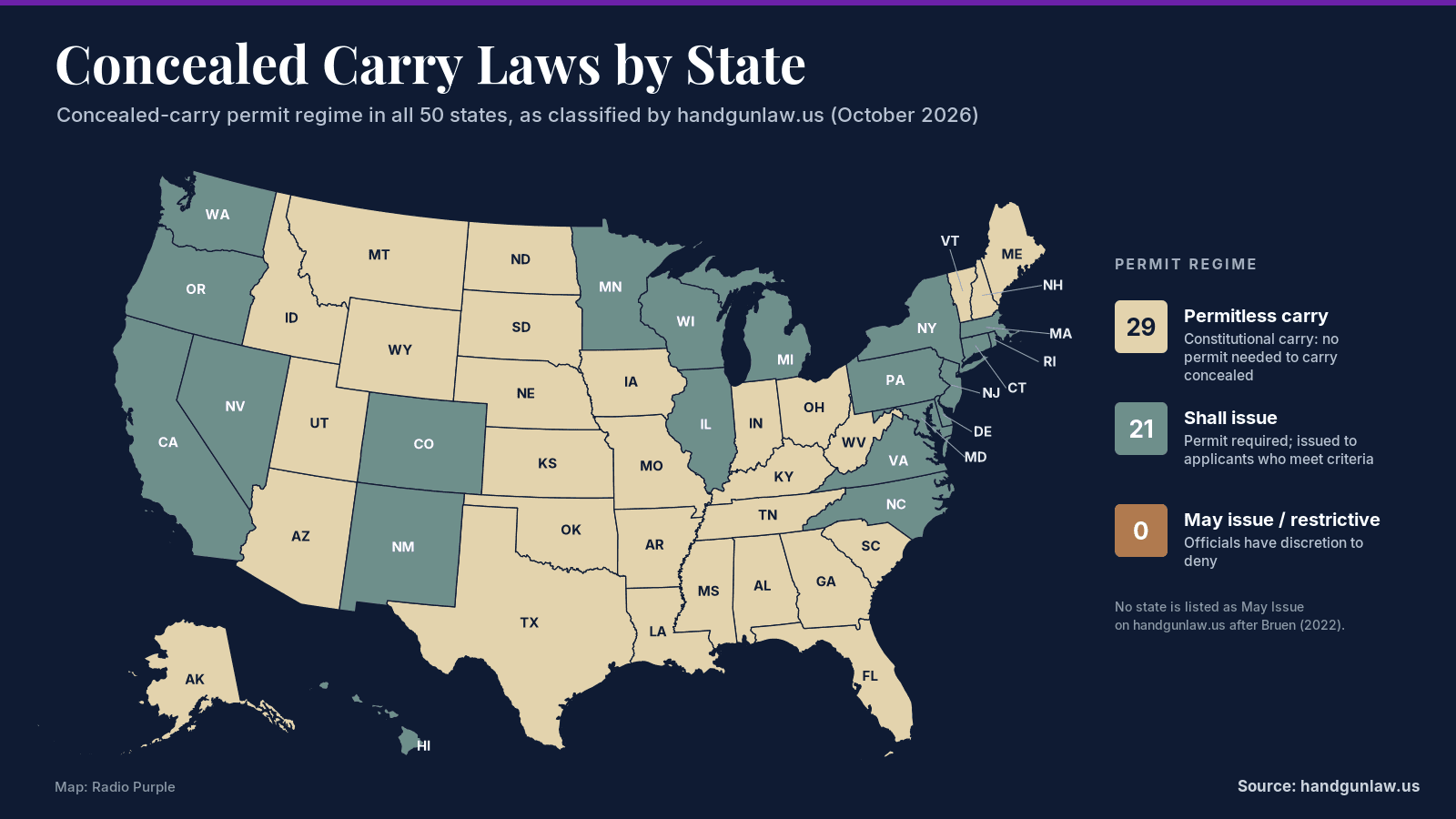
Next up. The Court is set to hear arguments Dec. 2 in a separate Second Amendment fight, over bans on AR-15-style rifles in Cook County, Illinois, and Connecticut (docket). For background on how courts have handled gun-free zones since Bruen, see our explainer, Where Can You Carry? Gun-Free Zones After Bruen.
What the Left Says
The progressive and Democratic case
Maryland, represented by Attorney General Anthony Brown, argued that its laws follow history. In its brief opposing review, the state said its laws "prohibit public carrying of firearms at only those discrete locations where restricting the carrying of firearms is consistent with history and tradition and their underlying principles."
The state pointed to Bruen itself, which "endorsed such 'longstanding' bans in schools, legislative assemblies, polling places, and courthouses, while recognizing that this list was non-exhaustive." The state also argued that appeals courts largely agree on these questions. "Although there may be minor disagreements among the circuits relating to particular locational restrictions," it wrote, "these minor disputes are overshadowed by the vast areas of shared consensus." It urged the justices to let lower courts keep working through the issue.
We found no posts from Gov. Wes Moore or Brown about Monday's order as of midday.
Where Reality Likely Sits
Radio Purple's analysis
There's real agreement on some places. Both sides accept that some places can be gun-free. Bruen named "legislative assemblies, polling places, and courthouses," and Thomas and Maryland both cite that list. In the Fourth Circuit, all three judges, including Judge Agee, who would have struck down the rest, agreed that Maryland's bans in government buildings, on school grounds and in healthcare facilities are constitutional. The challengers had contested those bans too, so the agreement doesn't extend to every school or government building.
The fight is over how far the list stretches. Maryland argues that Bruen allows bans in "new and analogous" sensitive places and that its transit, bar and park bans fit the historical tradition. The challengers say only places the government actually secures qualify. Maryland calls that view "unduly restrictive." It argued the challengers' theory could even let a state turn a grocery store into a sensitive place just by adding government security.
What happens next. Monday's order settles nothing nationally. Thomas asked for "an appropriate and more narrowly focused case," one that takes on a single type of place. Similar disputes over laws in New Jersey, New York, California and Hawaii, which he cited, could provide one. Until then, Maryland's bans stand.
What the Right Says
The conservative and Republican case
The challengers called Maryland's laws part of "a burgeoning trend of location-specific restrictions enacted by states, such as Maryland, that are openly hostile to the exercise of that right," in their petition. They warned that the answer "will determine whether Bruen establishes a meaningful right to public carry at all."
They proposed a test for what makes a place sensitive: security. "Where the government takes upon itself the burden to prevent unlawful entry with arms into a place frequented by the general public, then, and only then, may the individual right to armed self-defense be subject to a temporary restriction," they wrote. They described that security as "familiar to anyone entering a federal courthouse," which "typically takes the form of armed guards and magnetometers."
Thomas echoed much of that concern. He wrote that states "have seized on the idea of 'sensitive places' to prohibit the peaceable carry of firearms in locations that bear little resemblance to legislatures, polling places, or courthouses." He said the combined effect of such laws is "to prohibit firearms wherever people gather for eating, drinking, recreation, amusement, and free speech." He also wrote: "I harbor serious doubts that our Nation's historical tradition of firearm regulation supports many of these sweeping restrictions."
Sources & Citations
- Supreme Court of the United States, “Docket No. 25-1324, Novotny v. Moore”, November 16, 2026.
- Supreme Court of the United States, “Order List, Monday, November 16, 2026”, November 16, 2026.
- Supreme Court of the United States, “Statement of Justice Thomas respecting the denial of certiorari, Novotny v. Moore”, November 16, 2026.
- Supreme Court of the United States (docket filing), “Petition for a writ of certiorari, Novotny v. Moore”, May 20, 2026.
- Supreme Court of the United States (docket filing), “Brief of respondents in opposition, Novotny v. Moore”, August 17, 2026.
- Supreme Court of the United States (docket filing), “Reply brief of petitioners, Novotny v. Moore”, September 2, 2026.
- U.S. Court of Appeals for the Fourth Circuit, “Kipke v. Moore, No. 24-1799 (published opinion)”, January 20, 2026.
- Supreme Court of the United States, “Docket No. 25-238, Viramontes v. Cook County”, November 9, 2026.
Positions above are attributed to the public statements and published reporting cited here. Quotations are taken from these sources; Radio Purple does not publish unattributed or invented quotes. See an error? Request a correction.