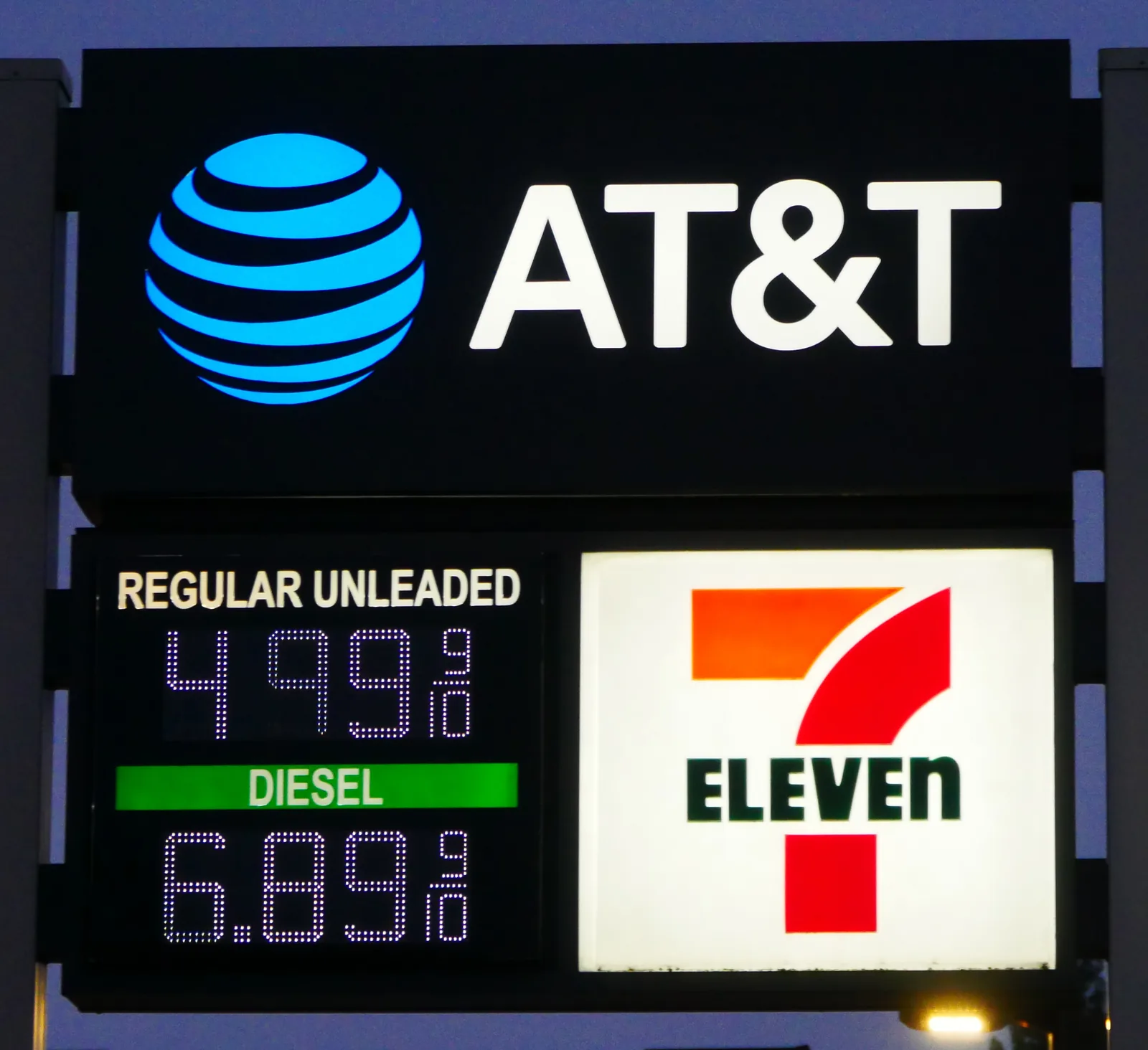
Gas Is Down About 59 Cents Since Election Day. The Slide Began in September.
AAA's national average for regular is $3.53, down from about $4.12 on Nov. 3. President Trump has suggested the timing was suspicious; federal data show prices were already falling for six weeks, with crude oil, refinery output and the seasonal fuel switch, analysts say, doing most of the work.
By Claire Hollister, Politics and Policy
Published · 7 min read
The Overview
The facts, straight
Gasoline has gotten a lot cheaper since Election Day, and the fight is now over why. President Trump has pointed to the timing and called it "interesting." Federal price data show the slide began about six weeks before the vote. Here is what the numbers say, who is claiming what, and where the evidence stops.
Where prices are. AAA's national average for a gallon of regular was $3.5305 on Nov. 28, against $3.0222 a year ago. On Election Day, Nov. 3, the AAA figure was about $4.12 in the daily series the Energy Information Administration (EIA) republishes. AAA's own Election Day release put it at $4.15, a record for a congressional Election Day. That makes the drop about 59 cents since Nov. 3, or about 62 cents from the $4.15 level. AAA's weekly releases track the slide: $4.10 on Nov. 5, $3.91 on Nov. 12, the first reading under $4 since July, and $3.72 on Nov. 19. Thanksgiving Day, Nov. 26, came in at about $3.56, two cents under the $3.58 holiday record set in 2022. Prices are still about 51 cents above last year.
How fast. EIA's weekly retail series peaked at $4.478 for the week of Sept. 21 and has fallen every week since: $4.153 on Nov. 2, $3.995, $3.805, then $3.642 on Nov. 23. About 32 cents of that decline came before the election. From Nov. 2 to Nov. 23, the average fell 51 cents in three weeks, and 63 cents over four. By our calculation from that series, which starts in 1990, those are the biggest three-week and four-week drops since late 2008, when they were larger. Neither AAA nor EIA calls this the fastest drop in 20 years. A claim that circulated this month, that prices had the "biggest drop in gasoline in 18 years," referred to a one-day figure from a Bloomberg columnist that GasBuddy's Patrick De Haan told FactCheck.org his own data did not show as the largest.
What moved. Crude oil fell first and furthest. On EIA's daily numbers, U.S. benchmark crude (WTI) was $110.01 a barrel on Oct. 19, $100.06 on Nov. 2, $91.73 on Nov. 4 and $81.42 on Nov. 23. Brent, the global benchmark, was $120.15 on Oct. 30, $107.03 on Nov. 3 and $91.84 the next day. Refiners ran hard: weekly utilization hit 97.5% for the week ending Nov. 20, the highest November reading in EIA's series since 1990. Wholesale gasoline in New York Harbor went from $3.07 a gallon on Nov. 3 to $2.44 on Nov. 25. Then there is the calendar. EPA's rules generally end the summer-grade gasoline season on Sept. 15, and AAA says stations are now selling cheaper winter blend and that demand falls in autumn. All of it sits on top of this year's Iran war: AAA Oregon/Idaho notes the national average was $2.98 on Feb. 28, the day the U.S. and Israel struck Iran, and the Strait of Hormuz disruption since then drove most of this year's spike. A refinery power outage in the Chicago area also helped push up prices in early September, De Haan told FactCheck.org.
A related household number. The American Farm Bureau Federation's 41st annual survey priced a Thanksgiving dinner for 10 at $58.63, more than 6% above 2025 and 8.5% below the 2022 record of $64.05. AFBF's volunteers shopped in the first week of November and cited high diesel costs and farm-labor shortages. Lower gasoline does not undo that.
What the Left Says
The progressive and Democratic case
The Democratic posts we reviewed do not credit the president for the drop. They say gas got expensive because of the Iran war and that the relief is partial. On Election Day, Sen. Elizabeth Warren wrote, "Don't forget: Donald Trump's war with Iran has sent your gas prices skyrocketing." Senate Democrats linked the war to heating costs on Nov. 11. House Democrats' Nov. 20 post makes the argument in full:
"Trump and Republicans have driven up the cost of oil and gas with their forever war in Iran," the post says, and promises that "House Democrats will put an end to this war and drive prices down." The numbers support part of the premise: AAA's average was $2.98 before the strikes and is $3.53 now, about 55 cents higher. They do not settle who is responsible. The war began in February, and the posts do not address why prices were already falling in October.
We did not find a post from a Democratic official alleging that companies held prices up before the election. Analysts quoted by fact-checkers do give Democrats' side one point to argue over. PolitiFact reports that some analysts think the Democratic win itself may have nudged oil prices, because crude trades on expectations about how Congress might handle the war. De Haan told FactCheck.org the president "elected to not really address" the problem earlier and had a lever he did not pull. Those are analysts' views, not findings.
Where Reality Likely Sits
Radio Purple's analysis
Both sides want lower pump prices for households, and both are pointing at the same public price series from AAA and EIA. That is as far as the agreement goes; we found no joint statement.
On the timing claim, the federal data do not fit the idea that prices were held up until the vote. EIA's weekly average fell every week from Sept. 21 on, and the president himself wrote on Nov. 2 that oil prices were "DROPPING LIKE A ROCK," FactCheck.org notes. Crude's biggest steps down came between Oct. 30 and Nov. 4, around the election. De Haan and other analysts tie that to Iran-related oil flows and to signals that the president did not want to escalate, not to company decisions. Trump also said on Nov. 20 that crude was "down 20% since the start of November." EIA's WTI spot price was down about 13% from Nov. 2 to Nov. 19 and about 19% by Nov. 23. Pump prices also fell more slowly than wholesale: New York Harbor gasoline dropped about 21% from Nov. 3 to Nov. 25, retail about 14%. That is consistent with the usual lag at the pump, not a hold-up.
The administration's credit claim is harder to sort. Falling crude, heavy refinery runs and the winter blend are doing most of the work, and analysts quoted by fact-checkers say seasonal drops happen every fall. De Haan also says the president's signals on Iran were part of it. Whether that counts as a policy win or the end of a policy-created spike is the argument the two sides are really having. Democrats are right that prices are still higher than before the war. The administration is right that they are lower than a month ago.
What we couldn't verify. We could not find Trump's Nov. 2, Nov. 17 or Nov. 22 posts on X, and we did not check Truth Social directly, so his words come from FactCheck.org and Yahoo Finance. An OANN story on his Nov. 22 posts returned a 403 and is not relied on. We did not locate the Bloomberg columnist's Nov. 12 post or see GasBuddy's underlying data. AAA does not describe the drop as record-setting; the "largest since 2008" comparison is our own calculation from EIA weekly data. FactCheck.org's EIA figures for the week of Sept. 21 and the week of Nov. 16 differ from the EIA table we pulled, so we used the table. We did not request comment from anyone for this story.
What the Right Says
The conservative and Republican case
The administration credits its energy policy and points to the decline as a success. The White House's Nov. 25 post:
The White House also posted on Nov. 22 about an "8-month low after 4 weeks of decline," the Department of Energy posted "Gas prices hit an 8-month low nationwide!" two days later, and the Rapid Response 47 account wrote on Nov. 26, "Trump policies worked." The refinery numbers above are real, and the decline since mid-November is steep by recent standards.
The second argument is about timing. According to FactCheck.org, Trump wrote on Nov. 17, "Biggest drop in gasoline in 18 years. Notice that they waited until after the 'Election?'" and said at a Nov. 20 news conference, "Too bad we didn't have that in front of the election." Yahoo Finance reports that on Nov. 22 he wrote, "Isn't it interesting that Oil prices have dropped precipitously after the Midterm Elections? I said that was going to happen. The whole thing is a Giant Hoax!" and, without evidence, that "the Dems and Iran fought like hell to keep the Oil price up as long as possible." We did not find these posts on Trump's X account; they are Truth Social posts as reported by those outlets. PolitiFact also reports posts, including one from an Instagram account named "Republican Party" that is not the party's official account and one from the commentator David J. Harris Jr., that say "the gas companies purposely increased the prices so you would blame Trump and vote blue." Other X accounts have posted similar claims. These are claims, and we have not seen evidence behind them. We are not embedding them.
Sources & Citations
- AAA, “AAA Fuel Prices: national average, regular $3.5305 as of 11/28/26”, November 28, 2026.
- AAA, “National Average Falls 12 Cents in One Week”, November 5, 2026.
- AAA, “For the First Time Since July, National Average Drops Below $4”, November 12, 2026.
- AAA, “Gas Prices Keep Dropping as Thanksgiving Approaches”, November 19, 2026.
- AAA Oregon/Idaho, “Gas Prices Drop but National Average is Highest Ever on a Congressional Election Day”, November 3, 2026.
- U.S. Energy Information Administration, “Weekly U.S. Regular All Formulations Retail Gasoline Prices (GASREGW)”, November 24, 2026.
- U.S. Energy Information Administration, “Today in Energy: daily prices, data for 11/03/26”, November 4, 2026.
- U.S. Energy Information Administration, “Today in Energy: daily prices, data for 11/25/26”, November 27, 2026.
- U.S. Energy Information Administration, “Weekly U.S. refinery utilization (WPULEUS3)”, November 25, 2026.
- U.S. Energy Information Administration, “Cushing, OK WTI spot price FOB (daily)”, November 27, 2026.
- U.S. Energy Information Administration, “Europe Brent spot price FOB (daily)”, November 27, 2026.
- U.S. Energy Information Administration, “This Week in Petroleum (archive; EIA says it no longer publishes it)”, November 28, 2026.
- U.S. Environmental Protection Agency, “Gasoline Reid Vapor Pressure (summer season generally ends Sept. 15)”, November 28, 2026.
- American Farm Bureau Federation, “Cost of Thanksgiving Dinner Increases, Remains Below 2022 Record High”, November 18, 2026.
- PolitiFact, “Falling gas prices aren't proof gas companies inflated prices to hurt Trump”, November 11, 2026.
- FactCheck.org, “Trump's Misguided Claim That 'They' Waited to Lower Gas Prices Until After the Midterms”, November 20, 2026.
- Yahoo Finance, “'A Giant Hoax': Trump suggests recent gas price drops are linked to the election”, November 23, 2026.
- The White House, “The White House on X: gas prices 'collapsing at a historic rate'”, November 25, 2026.
- House Democrats, “House Democrats on X: 'forever war in Iran'”, November 20, 2026.
Positions above are attributed to the public statements and published reporting cited here. Quotations are taken from these sources; Radio Purple does not publish unattributed or invented quotes. See an error? Request a correction.